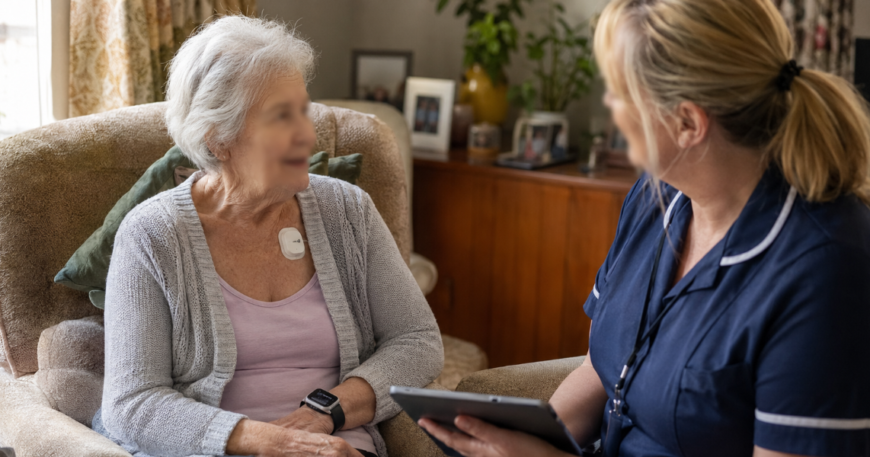
England’s 10-year health plan names wearables as one of five transformative technologies that will reshape care delivery by 2035. The ambition is concrete and timed. Closing the distance between policy commitment and clinical reality is where the real work lies.
When England’s 10-year health plan was published on 3 July 2025, it did something that previous NHS strategy documents had largely avoided: it made specific, timed commitments to wearable technology as a structural component of clinical care rather than a peripheral innovation. The plan named wearables as one of five transformative technologies, alongside artificial intelligence, genomics, robotics and data, that would be central to how the NHS delivers care over the coming decade.
Those commitments are now a year old. The question has moved on from what the NHS intends to do with wearable technology to whether the systems, infrastructure and clinical frameworks needed to support those intentions are actually being built.
What the Plan Actually Commits To
The NHS 10-year plan’s wearables commitments are specific enough to be measurable. The plan commits to expanding hospital-at-home programmes in the first three years and to expanding NICE’s digital programme to consider more medical-grade wearables. It states that wearables will be standard in preventative, chronic and post-acute NHS treatment by 2035 and that all NHS patients will have access to these technologies as part of routine care.
More concretely, by 2028 remote monitoring for cardiovascular disease using wearables and other devices is to become a standard part of NHS care. The plan also commits to enabling citizens to integrate data from smartwatches and other personal devices with their Single Patient Record, fed through a new My Health feature in the NHS App that will connect wearable data with test results and medical records to provide personalised health advice.
The cardiovascular commitment is the most clinically grounded of the plan’s wearables pledges and the most achievable in the near term. Atrial fibrillation screening using wearable electrocardiogram technology has been evaluated in multiple clinical settings. Virtual wards for patients with heart failure and respiratory conditions are already operating across several NHS trusts, combining wearable sensors with remote monitoring teams and defined escalation pathways. The plan explicitly states that wearables provided within these NHS pathways will be available free in areas with high deprivation or health need, framing access as a structural commitment rather than a market question.
The Infrastructure Challenge
The plan’s ambitions rest on infrastructure that does not yet exist at scale across the NHS. The most significant gap is interoperability. Wearable devices generate data in formats that vary across manufacturers, and that data currently sits outside NHS electronic patient record systems in the majority of clinical settings. A clinician reviewing a patient in a virtual ward may have access to readings from a chest patch, a pulse oximeter and a blood pressure cuff, each feeding into different platforms with different alert thresholds and different notification routes.
That fragmentation is a structural barrier to safe clinical use rather than a minor inconvenience. The solutions that tend to be adopted most effectively are those that do not create additional work for clinicians. That principle is proving difficult to deliver in practice. Integrating wearable data streams into electronic health record and clinical alerting systems requires investment in technical infrastructure, information governance agreements and clinical workflow redesign that most NHS trusts are not yet resourced to undertake at the pace the 2028 cardiovascular target demands.
A digital and data blueprint expected from NHS England in 2026 is intended to address technology infrastructure, the digital profession and operating standards in the context of these national programmes, providing a clearer framework for implementation and helping to align local efforts with national priorities. Whether it does so with sufficient precision to resolve the interoperability problem is the central operational question of the next twelve months.
Greater Manchester as a Test Case
Greater Manchester is one of the more advanced examples of what coordinated investment can achieve. An £11.1 million funding commitment was announced in June 2026 to launch the Greater Manchester Wearables and Remote Monitoring Innovation Cluster, known as GM-WIC, bringing together Manchester University NHS Foundation Trust, the University of Manchester, Manchester Metropolitan University and the NIHR Manchester Health Determinants Research Collaboration in a triple helix model with commercial partners.
The cluster aims to remove barriers facing companies and innovators developing wearable and remote monitoring technologies by creating a single access point for research, testing and deployment. It will develop a unique data infrastructure linking wearable devices with routinely collected NHS health data, support innovation through accelerator programmes and real-world testing platforms, and create clearer adoption pathways to help products move from concept to deployment at scale.
Mark Cubbon, chief executive of Manchester University NHS Foundation Trust, described wearable and remote monitoring technologies as pivotal to the future of healthcare and central to the ambitions of the NHS 10-year plan, adding that the cluster was designed to remove barriers and encourage investment, bringing the latest innovations and lasting impact.
That kind of geographically concentrated investment is a sensible model for generating the evidence and operational learning the rest of the NHS will need. It also illustrates how uneven the pace of progress remains nationally. Greater Manchester is moving faster than most. The 2028 cardiovascular monitoring target applies to the whole system.
The Clinical Validation Problem
Not all wearable devices are clinically equivalent, and the plan’s commitment to expand NICE’s digital programme reflects a recognition that the current evidence and evaluation landscape has not kept pace with the speed of the market.
Consumer smartwatches and clinical-grade monitoring devices are not the same category of product. A smartwatch that detects an irregular heart rhythm and prompts a GP appointment is a fundamentally different clinical proposition from a validated monitoring device embedded in a structured virtual ward pathway with defined response protocols and escalation thresholds. The plan does not fully resolve that distinction, and the risk is that pressure to scale wearable use quickly leads to deployment of devices whose clinical evidence base is thinner than the clinical context demands.
The practical model for effective wearable use in NHS settings is clear in principle: a structured care pathway combining a device, a patient-facing application, automated alerting and review by a clinical team, with defined thresholds for action and clear accountability for follow-up. The value comes from connecting the data to an agreed response rather than from the data alone. Building that infrastructure consistently across a health system of the NHS’s scale, serving populations with vastly different digital access, health literacy and connectivity, is the operational challenge that no strategy document alone can resolve.
Equity as a Structural Requirement
The plan is explicit that wearable technology must be accessible to all patients. That commitment addresses a real structural risk. Consumer wearable ownership correlates strongly with income, age and digital literacy. If the NHS’s wearable infrastructure relies on devices that patients own themselves or can afford to acquire, it will systematically disadvantage the populations with the greatest clinical need.
The plan’s response is to frame NHS-issued wearables as standard care within treatment pathways, with free provision targeted at areas of highest deprivation and health need. That is the right model. Whether it is funded adequately, at the volume required to serve the populations targeted by the 2028 cardiovascular monitoring commitment, will be determined by NHS England’s procurement decisions over the next two years rather than by the strategy document.
The ambition to position wearable technology as a universal NHS tool rather than a consumer product for the digitally engaged is one of the more significant equity commitments in the plan. Delivering it requires capital investment, workforce training and interoperability standards that multiple NHS organisations and industry partners have been working to resolve for years without reaching the consistency the plan now demands.
Where Things Stand
Early movement is visible. Virtual ward programmes are growing across England, using remote monitoring to support patients recovering at home from acute illness. Connected devices are being used with increasing regularity in cardiovascular and respiratory care pathways. Several integrated care systems are piloting community-based monitoring models for long-term condition management. Progress is real, though it is concentrated rather than uniform.
The 2028 milestone, making remote cardiovascular monitoring a standard part of NHS care, is now two years away. Whether the interoperability infrastructure, NICE evaluation pathways, clinical governance frameworks and procurement mechanisms needed to support that commitment can be built at the required pace is the most important near-term test of whether the NHS’s wearables ambition translates into routine clinical practice.
The technology exists. The clinical evidence for specific use cases, particularly cardiac monitoring, is solid and growing. The NHS has articulated its strategic commitment in clearer, more specific terms than any previous health plan. What remains is the operational delivery, which is invariably where the gap between NHS strategy and NHS practice is either closed or quietly widened.
Sources: NHS 10-Year Health Plan, 3 July 2025; NHS Confederation; Burges Salmon; Osborne Clarke; Manchester University NHS Foundation Trust, June 2026; Greater Manchester Combined Authority, June 2026; HTN Health Tech News; KLES Digital Health; NHS Alliance Digital Transformation Reference Guide; Digital Health; Health Tech Magazine.