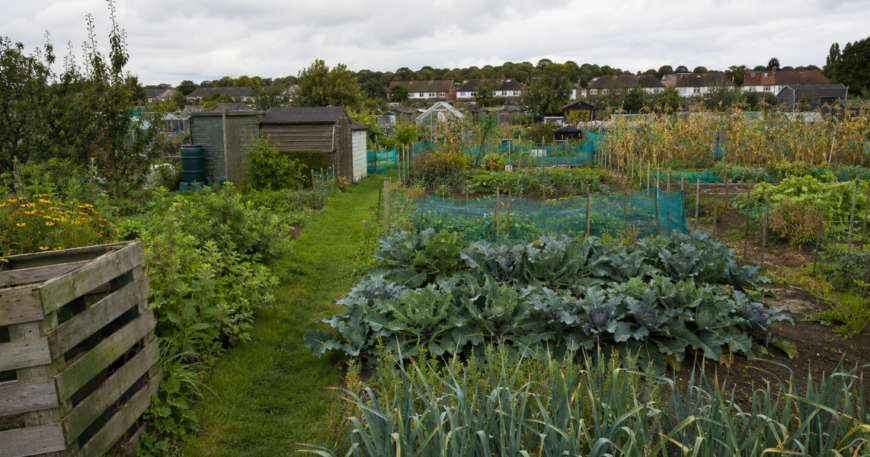
Across the UK, well over 100,000 people are currently on a waiting list for an allotment, with an average wait of around four years before a plot becomes free. That level of sustained demand for a patch of soil and a shed is unusual enough to be worth asking why, and life sciences research is starting to offer some genuine answers. A national evaluation of gardening as a form of NHS-linked treatment has found wellbeing improvements that stand up to statistical scrutiny. Soil scientists are trying to close a widening gap between what laboratories know about the organisms living in soil and what the people actually growing food in it believe. And decades-old work on soil bacteria and mood is still shaping how researchers think about the mechanism behind it all. Gardening did not need life sciences to make it worthwhile, but life sciences is increasingly interested in why it works.
A Waiting List Nearly Four Years Long
An analysis of Freedom of Information responses from 175 local councils across the UK, published in 2025, found 108,958 people waiting for an allotment plot, with an average wait time of around four years. It is one of several recent counts of allotment demand, and the exact totals vary a little depending on which councils respond and when the count is taken, but every version of the exercise tells the same basic story of demand that has outpaced supply for years. The picture varies sharply by area. The South East accounts for the largest single share, with almost 21,000 people waiting, while councils including West Dunbartonshire and the London Borough of Haringey report average waits of nine years. Several other councils, among them Lewisham, Bolsover and East Riding, sit at around eight years.
Numbers like these are not, on their own, evidence of anything beyond demand outstripping supply, but they set the scale for everything that follows. This is not a niche hobby with a small, dedicated following. It is a form of activity that hundreds of thousands of people are prepared to wait years for, at a time when councils have limited land and limited budgets to expand provision. That gap between appetite and access is precisely what has made gardening and food growing an attractive target for researchers asking whether the wellbeing benefits people report anecdotally can actually be measured.
What Green Prescribing Actually Measured
Green social prescribing, referring GPs to nature-based activities rather than, or alongside, medication, has been running as a formal test-and-learn programme across seven sites in England, coordinated with DEFRA. An evaluation published in May 2025 by the NIHR’s Applied Research Collaboration for Yorkshire and Humber looked at more than 200 participants with mental health problems who took part in one of three categories of activity: horticulture and care farming, sport and physical activity, or creative and other outdoor-based activities, tracked using the ONS-4 wellbeing measure and the Hospital Anxiety and Depression Scale before and after their involvement.
The results showed statistically significant improvements in life satisfaction, happiness and a sense that life was worthwhile, alongside reductions in anxiety and depression symptoms. Two patterns stood out. Longer engagement mattered: people who took part for nine weeks or more saw stronger effects than those who took part for four weeks or fewer. And horticulture and care farming, the category that includes allotment and community gardening work, produced the strongest results of the three activity types. The researchers noted that the size of the effect on anxiety and depression was comparable to what is typically seen with established primary care treatments such as cognitive behavioural therapy, a striking claim for an intervention that mostly consists of digging, weeding and growing food.
The Gap Between the Lab and the Allotment
The wellbeing case for gardening has a plausible biological starting point in research that is now nearly two decades old. In 2007, researchers at the University of Bristol and University College London found that Mycobacterium vaccae, a harmless bacterium commonly found in soil, activated serotonin-producing neurons in mice in a pattern similar to that seen with antidepressant drugs. The work began from an unexpected clinical observation: cancer patients treated with the bacterium in an earlier trial had reported an improved quality of life that could not be explained by their cancer treatment alone. It is a mouse study of a specific bacterium, not direct proof that turning over soil in an allotment produces the same effect in a human brain, but it gives researchers a concrete mechanism worth testing rather than a vague appeal to fresh air.
More recent work has shifted from mechanism to practice. A 2026 study from the University of Sheffield’s Department of Animal and Plant Sciences, based on interviews with UK growers, examined how farmers and gardeners actually understand and manage the soil microbiome, and how they view commercial soil inoculant products designed to boost it. The researchers found a wide gap between the science of microbial inoculants and how growers actually use, or ignore, that science, with most relying instead on experiential knowledge built up over years of working the same ground. Their recommendation was that future product development should involve growers directly, rather than treating soil science as something to be handed down finished. It is a useful corrective to any assumption that the people on allotment waiting lists are simply waiting for scientists to tell them what to do. In practice, a lot of the working knowledge about soil already sits with them.
Why the Life Sciences Keep Digging Here
None of these three threads, the size of the waiting list, the wellbeing data and the soil science, would carry much weight alone. Together they describe something more specific: an activity that huge numbers of people already value enough to wait years for, that formal healthcare evaluation is now able to measure with the same tools used to judge conventional treatment, and that still has real gaps between what the laboratory understands and what the person with the trowel understands. Allotments and gardens were never going to need a research paper to justify themselves to the people already queuing for a plot. What is changing is how much of that value the life sciences can now actually demonstrate, measure and explain.
Sources: Freedom of Information data on UK council allotment waiting lists (2025); NIHR Applied Research Collaboration Yorkshire and Humber; DEFRA green social prescribing programme; University of Bristol; University of Sheffield.