By: Russell Sutherland (Biotech Product Consultant)
Over the past five years, the narrative around AI in drug discovery has centred on a couple of breakthroughs: The first was AlphaFold. What started as a revolution in protein structure prediction has quickly expanded into predicting the shapes of RNA, antibodies, complexes, and entirely new biological assemblies as seen in the more recent Alphafold 3 model. This shift has spawned an ecosystem of companies racing to design better molecules by exploiting improved 3D structural insight. The other development was of course the advent of the large language model as a serious piece of kit with GPT-3 and chatGPT. It enabled researchers to imagine what would be possible when most problems in compound design Machine learning could be reframed using these tools: How can we design a medicine to better target a protein of interest based on the fact that we know the shape of our compound and protein?
We have witnessed extraordinary achievements, but there now may be a system-level imbalance in where investment is going based on what we can do now versus what is the main pain point and resource sink in drug development.
| Early Drug Discovery Spans four key questions: 1. Which biological target should we hit? (Target Identification) 2. How do we design a molecule that can hit it? (Drug Design) 3. Is it safe? (Preclinical toxicology and Phase 1 safety trials) 4. Does it work? (Preclinical efficacy studies and, ultimately, Phase 2 clinical trials) AI has transformed step (2). But the biggest and costliest failures still happen at step (4), which depends heavily on step (1). |
In the last 5 years a striking proportion of biotech funding has flowed into platforms building better binders: generative chemistry models, structural docking, de novo protein design, biologics modelling, and molecular shape optimisation. However, there are signs the tide is beginning to turn. Over the last 18–24 months, several new platforms and partnerships have explicitly focused on AI-driven Target-ID rather than downstream chemistry. Launches such as Genomics plc’s Mystra, new clinically anchored Target-ID platforms from Owkin, and partnerships like AstraZeneca–Tempus–Pathos and Exscientia–Sanofi point to a shift in emphasis toward upstream biological decision-making. Even in the last month of 2025 we saw new partnerships with an eventual value of around $1.7B for Relation Therapeutics, a British AI drug discovery using a lab-in-the-loop approach, with Novartis, and Deerfield Management. While design-focused AI still dominates total capital, Target-ID is clearly emerging as a growing and increasingly investible category.
Most of the commercial AI-drug discovery platforms seem to sit firmly in the drug design space where the investment story is simple “Here is a better, cleaner molecule we designed with AI”. Perhaps as shareholders and investors have become more aware of the true bottlenecks in drug development – the investment landscape is changing.
The problem is that the drug design bottleneck is not what breaks R&D productivity.
The Biggest Failure Point Is Efficacy – Choosing the Wrong Target
For a decade, we have known that the largest and most expensive source of attrition in R&D is Phase 2 clinical failure. Depending on the therapeutic area, roughly half of all Phase 2 trials fail on efficacy alone. By this point a company may have spent $50M+ building and testing a candidate that never had a chance.
What does a phase 2 clinical trial really measure?
Phase 2 clinical trials are the first point where we test whether a drug actually works in patients with the disease. They assess efficacy, not just safety. These trials are large, expensive, and where most drug candidates ultimately fail. Improving Phase 2 outcomes depends heavily on choosing the right biological target at the very start of the pipeline.
Peer‑reviewed analyses published over the last decade confirm the scale of this problem. Analyses of 2010–2017 clinical trial data estimate that around 40–50% of clinical development failures are driven by lack of clinical efficacy (Sun et al., 2022). In Phase II specifically, cross‑industry and company‑level datasets suggest that roughly 50–70% of Phase II terminations are primarily due to insufficient efficacy (Arrowsmith & Miller, 2013; Feijoo et al., 2020; Wu et al., 2021). Late‑stage analyses of pivotal trials show a similar pattern, with 57% of failed agents in Phase III or at registration failing for lack of efficacy (Hwang et al., 2016), and some therapeutic areas such as neurology and respiratory disease seeing more than 70–80% of failures attributed to poor efficacy rather than safety. Together, these findings emphasise that the biological hypothesis behind the drug, not the chemistry, breaks most often.
Against this backdrop, human genetics offers one of the strongest forms of target validation. Nelson et al. (2015) demonstrated that drug programmes backed by human genetic evidence are twice as likely to succeed from Phase II onwards. More recent large‑scale analyses show 2-3× higher likelihood of success when the chosen target has robust genetic support (Minikel et al., 2024, King et al., 2019).
We’ve Been Optimising the “Wrong” Part of the Pipeline
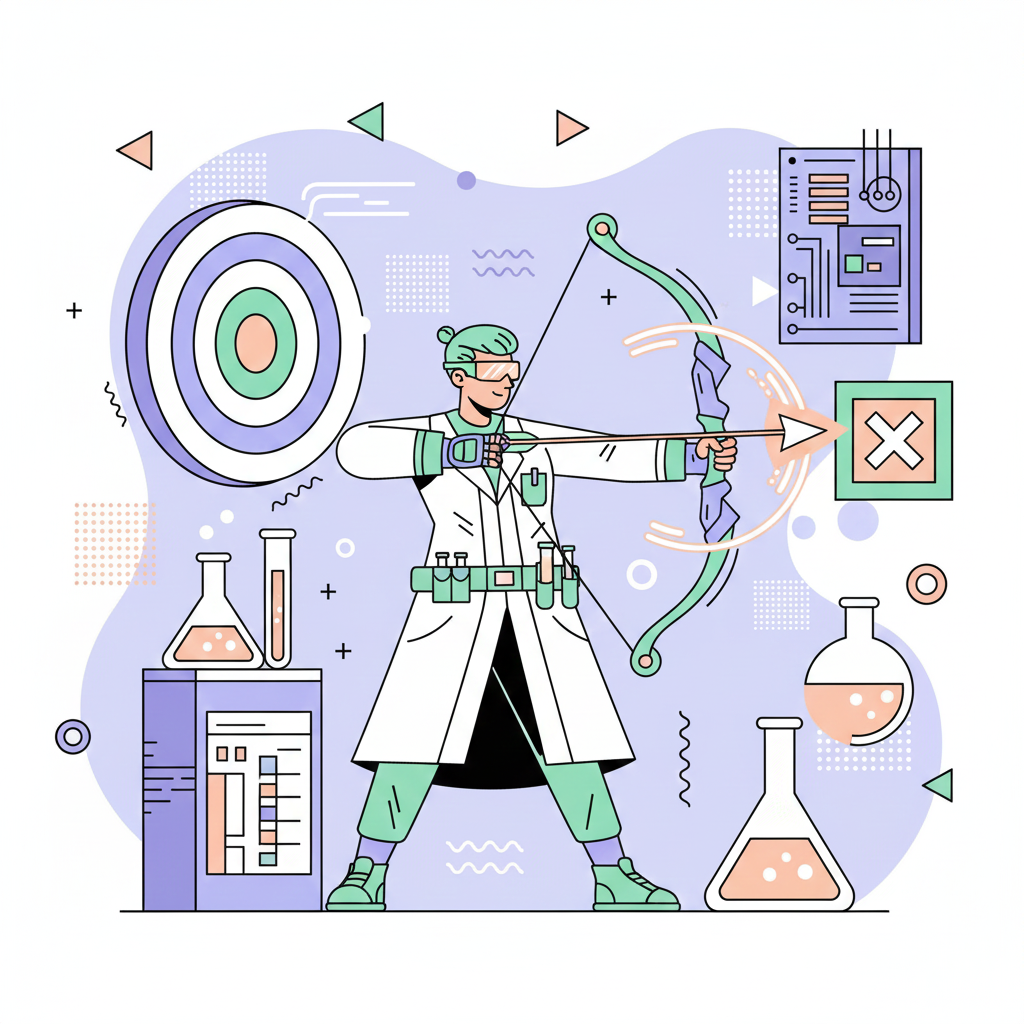
Drug discovery is like archery. We’ve spent billions optimising the arrows – making them fly straighter, faster, and more precisely. We’ve even upgraded the bow with generative models and multimodal AI. But if we’re aiming at the wrong target, none of that matters. Better arrows don’t compensate for poor aim. Choosing the right biological target is the act of aiming, and it determines whether all the downstream engineering can succeed.
AI-accelerated drug design, without better target selection and trial design, increases the rate at which programmes reach the most expensive point of failure. The industry as a whole seems to be learning this.
Why has Target Identification had comparatively Little AI Attention until now?
1. Data scarcity: While chemical and structural data is abundant, high-confidence causal datasets linking proteins to disease are rare and often closely guarded.
2. Biological complexity: Targets act within networks. Causal inference is hard, especially in multifactorial diseases, although there are some techniques that can help disentangle causality.
3. Delayed feedback loops: You don’t know if a target works until years after a clinical trial begins. However, this doesn’t mean we should just accept the situation. We can provide information to calibrate the “Big Bets” that companies make at these early stages.
4. Commercial optics: It’s easier to pitch “AI-designed molecules” than probabilistic target validation. Perhaps shareholders want to see the organisation adopting AI. Drug design, quite rightly, is the first place to try to use it.
As a result, while investment into generative AI for chemistry is booming, AI applications for target identification receive a fraction of the funding, although that is increasing. Historically, a substantial majority of startup and partnership capital in AI‑enabled drug discovery has flowed into generative chemistry, protein design, and modality optimisation, with only a smaller share directed toward companies working on Target‑ID or efficacy prediction. While exact proportions vary across analyses and years, most investment tracking reports agree that funding has been significantly weighted toward design-focused platforms, even as a growing number of investors and biopharma partners are beginning to prioritise upstream biological decision-making. This leaves the industry over‑investing in downstream engineering and under‑investing in the upstream biological decisions that determine whether a drug will work.