A smartwatch tested against a mercury sphygmomanometer at 4,014 metres has just shown exactly where consumer health tech stops being trustworthy, a cargo drone in the Dolomites has cut mountain rescue evacuation times by two-thirds, and a review of decades of hiking research has quantified, in hard clinical numbers, why a walk in the hills counts as medicine. Hiking and mountaineering are not usually filed under life sciences, but in 2026 the overlap is becoming difficult to ignore.
Extreme and remote environments have always been useful to medicine precisely because they push the human body, and the technology strapped to it, past the point where things quietly work. A hospital ward rarely reveals a wearable sensor’s blindspots. A 4,000 metre ridge line does. Three separate strands of research and development this year, spanning consumer wearables, emergency medicine and public health, all trace back to people moving through mountains and hills, and each has something concrete to say about the life sciences sector back at sea level.
A Smartwatch Meets Its Limits at 4,000 Metres
In February, researchers from West China Hospital at Sichuan University, working with engineers from Huawei, published a study in Frontiers in Physiology testing how accurately a consumer smartwatch could measure blood oxygen and blood pressure across a genuine altitude gradient, from Chengdu at 500 metres up to Litang at 4,014 metres. The study compared 24 lowland migrants tracked as they ascended against 85 long-term residents already living at altitude, measuring the watch’s readings against a reference pulse oximeter and a traditional mercury sphygmomanometer.
The results were reassuring in one respect and cautionary in another. Blood oxygen readings stayed within the accuracy threshold set by the relevant international standard at every altitude tested, supporting the watch’s use for simple trend monitoring. Blood pressure was a different story. Above 2,500 metres, and particularly during acute ascent, the watch’s systolic and diastolic readings deviated from cuff-based measurements by more than the accepted margin, with errors most pronounced in the newly arrived migrant group rather than long-term residents whose bodies had already adapted. The authors were direct about what that means in practice, concluding that blood pressure readings “warrant cautious interpretation” above 2,500 metres, particularly during the acute phase of ascent, and that the case for substituting a cuffless, watch-based reading for a traditional cuff “reinforces the need for careful consideration” in physiologically stressed conditions like these. It is exactly the kind of finding that only shows up when a device is tested somewhere genuinely hostile to it, and it matters well beyond mountaineering, since the same consumer wearables are increasingly used to monitor people with high blood pressure at sea level too.
The Rescue Helicopter’s Understudy
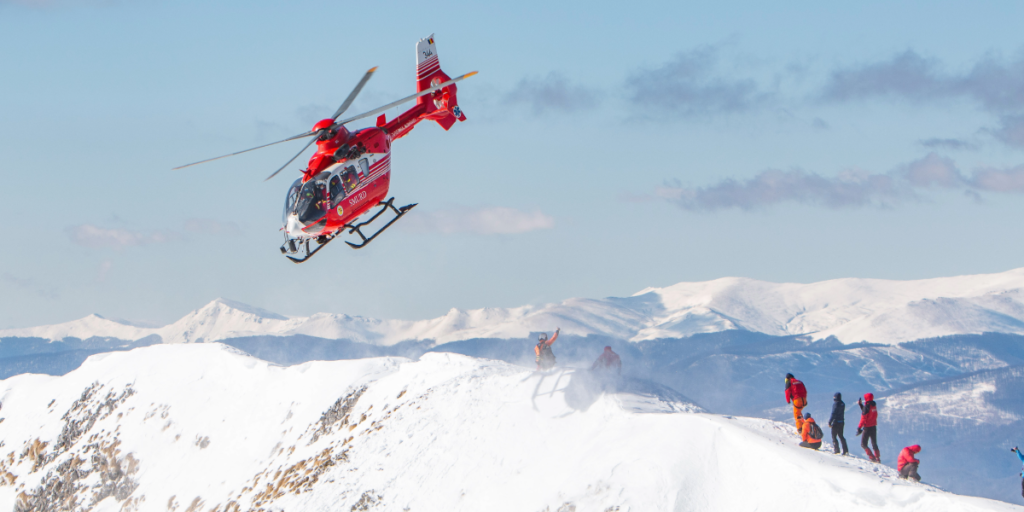
If wearables reveal where medical technology’s limits sit, the Dolomites have spent the past two years testing what can be built to work around them. The START2 Living Lab project, backed by the EU’s Interreg Italy-Austria programme and led by a consortium including Eurac Research’s Institute of Mountain Emergency Medicine and the drone manufacturer FlyingBasket, has spent 2024 to 2026 trialling heavy-lift cargo drones for mountain casualty evacuation. Field tests reported in June found that drone-assisted evacuations cut transfer times by up to three times compared with traditional ground-based rescue, while reducing the shocks and vibrations experienced by an injured patient by up to tenfold.
The project also produced a genuinely new piece of rescue technique: a “hot loading” procedure that allows a patient to be safely loaded onto a hovering drone rather than waiting for it to land, developed jointly with mountain emergency medicine researchers at Eurac. Moritz Moroder, FlyingBasket’s chief executive, called it evidence of “a fundamental shift: drones are no longer just support tools, but can become an active part of rescue operations.” Michiel van Veelen, a researcher at Eurac’s Institute of Mountain Emergency Medicine, was more cautious about the horizon this points towards, but no less clear about the destination: “If we implement this technology in the future, we can make mountain rescue much safer and less dependent on technology like helicopters.” Mountain Rescue England and Wales has separately continued equipping its volunteer teams with drones through 2026, with its Lake District team receiving a new unit in April.
The Evidence That a Walk in the Hills Is Preventive Medicine
The third strand is less about new technology and more about tallying up what has already been proven. An integrative review published in Frontiers in Public Health in January, led by researchers at Beijing Sport University and Hunan Normal University, pulled together decades of meta-analyses and systematic reviews on outdoor hiking to quantify its physical and mental health effects in a single place. The physical numbers are substantial: one meta-analysis of 42 studies included in the review found hiking associated with an average systolic blood pressure reduction of 3.72 mmHg and a diastolic reduction of 3.14 mmHg, alongside measurable improvements in resting heart rate, body fat percentage and six-minute walk distance, a standard clinical marker of cardiovascular fitness. On mental health, reviews included in the paper reported moderate to large reductions in depressive symptoms and anxiety and corresponding increases in positive affect, consistent enough across studies to describe hiking’s mental health benefit as one of the more reliably reproduced findings in the exercise literature. The review’s authors concluded that “outdoor hiking not only reduces the incidence of chronic diseases and promotes mental health improvements but also generates significant economic benefits, especially in tourism, employment, and related industries,” while noting that a standardised way of measuring those economic benefits still does not exist.
That evidence base already has a policy home in England. The cross-government Green Social Prescribing programme, a £5.77 million initiative running since October 2020 and project-managed at various stages by Defra and NHS England, has used exactly this kind of research to justify referring patients to nature-based activities, walking groups among them, instead of or alongside conventional treatment. Its first phase, running to March 2023, referred more than 8,500 people, with 85% take-up once offered and a social return on investment of up to £2.42 for every £1 spent, concentrated in areas with the highest socioeconomic deprivation. A second phase, backed by nearly £4 million of further funding, ran through March 2025, with further evaluation still to be published.
Same Terrain, Three Different Lessons
None of these three stories would usually sit in the same article. A cardiology paper about smartwatches, an EU-funded drone trial and a sports science review of hiking studies belong, on paper, to different disciplines entirely. What connects them is the mountain, or the hill, or simply the outdoors, as a proving ground: a place demanding enough to expose a wearable’s blind spots, remote enough to justify rebuilding how casualties are evacuated, and accessible enough that its health benefits can be prescribed to millions of people who will never go near a summit. Hiking and mountaineering are not adjacent to life sciences by coincidence. They are one of the places life sciences goes to find out what is actually true.
Sources include Frontiers in Physiology, Frontiers in Public Health, Eurac Research, FlyingBasket, Mountain Rescue England and Wales, and the National Academy for Social Prescribing.