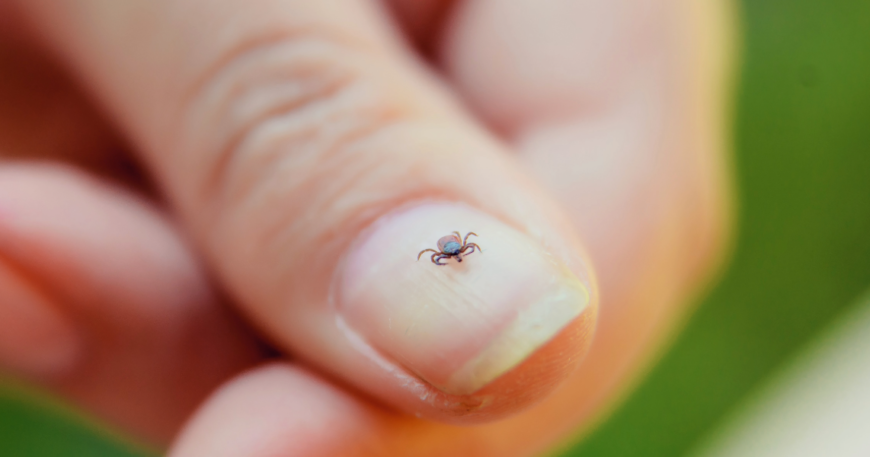
A New Virus and a Shifting Map: What’s Changing About Ticks in Britain

Ticks have never been exotic in Britain, and Lyme disease has been a known, if modest, seasonal risk for decades. What has changed is how closely officials are now tracking it. In May 2026 the UK Health Security Agency and its partners published the country’s first annual vector-borne disease surveillance report, bringing together Lyme disease case data, the slow emergence of a virus Britain barely had a few years ago and a separate study of Scottish hill runners that puts hard numbers on just how differently exposed some groups already are. None of this points to a sudden outbreak. It points to a country whose surveillance is only now catching up with a landscape that has quietly become more hospitable to ticks.

The First Annual Look at Britain’s Ticks

UKHSA’s report, published on 21 May 2026, is the first of its kind, bringing several agencies together under a “One Health” approach that treats human, animal and environmental data as one connected picture. Lyme disease remains the most common locally acquired vector-borne infection in England, with 1,168 laboratory-confirmed acute cases recorded in 2025, up from 959 in 2024 and close to the 1,151 seen in 2023. That is less a steady rise than a return to an earlier level after a lower year, and the comparison comes with a caveat: from 2025 UKHSA applied a new “one-year episode window” to its case definition, counting only one positive laboratory test per person within any 12 month period, a methodology change the agency itself says should be kept in mind when reading trends either side of that date. Seen over a longer run, UKHSA’s published surveillance shows the annual infection rate rising from 0.38 per 100,000 people in the late 1990s to a peak of 2.77 per 100,000 in 2018, before easing back to 1.94 by 2021, the most recent year for which a comparable rate has been published.

Of the 2025 cases, just over 48 per cent were male and just under 48 per cent female, with a median age of 48 among men and 50 among women and cases recorded from as young as 1 to as old as 87, a spread UKHSA’s longer-run analysis has separately described as peaking among those aged 45 to 64, followed by those aged 25 to 44. That skews the picture away from the assumption that children playing outdoors are the main group at risk, and towards adults out gardening, dog walking or otherwise spending time in the countryside. Tick exposure itself peaks across spring and summer, and diagnoses of acute Lyme disease in 2025 followed suit, peaking in the third quarter of the year, July to September, reflecting the lag between a bite and a confirmed diagnosis. Professor Lea Berrang-Ford, Deputy Director of UKHSA’s Centre for Climate and Health Security, summed up the underlying shift driving the new report: the “risk picture is changing due to factors including climate change, urbanisation and the globalisation of trade and travel.”

A Virus Britain Didn’t Used to Have

Lyme disease is long established here. Tick-borne encephalitis is not. The cases that first put the virus on the public’s radar were confirmed in 2022, when UKHSA identified infections acquired within the UK in two people, one of them linked to mountain biking on the North Yorkshire Moors, alongside a probable case whose infection was thought to have been picked up in Scotland’s Loch Earn area. The story broke the following spring, in April 2023, reported as the first confirmed evidence that the virus could establish itself in British ticks rather than only being brought home by travellers. At the time, UKHSA’s Dr Meera Chand said surveillance suggested the virus was “very uncommon in the UK and that the risk to the general population is very low,” while Professor Ian Jones of the University of Reading noted that “wearing appropriate clothing essentially removes the risk” and expected any further cases to remain “sporadic in nature.”

The 2022 cases were not, it later turned out, the earliest sign of the virus circulating here. A retrospective review of UK testing data published in Eurosurveillance in February 2025 traced two further probable UK-acquired cases back to 2019 and 2020, cases that had not been recognised as such at the time. Taken together with two more probable cases identified in 2025, in people with no history of travel abroad, UKHSA’s 2026 report now puts the total number of locally acquired or probable tick-borne encephalitis cases at six since 2019. Diagnosis is complicated by the fact that laboratory tests cannot always distinguish the virus from louping ill, a related virus long known in British sheep and grouse, so some cases are recorded only as “TBE complex” rather than confirmed encephalitis. Where illness does occur it ranges from no symptoms at all to a serious condition involving high fever, neck stiffness, confusion and seizures, though UKHSA continues to describe the overall risk to the public as very low. The slow accumulation of cases is broadly consistent with what a Glasgow-led research project, funded by the Natural Environment Research Council, set out to investigate back in 2022, when it identified rising woodland cover, growing deer numbers and climate change as the established drivers of tick-borne disease risk across Europe.

Why Hill Runners Are a Useful Warning Sign

Public Health Scotland runs its own seasonal awareness campaign for exactly this reason, reminding the public each spring that Lyme disease remains the country’s most common tick-borne illness and repeating the standard precautions: long sleeves and trousers tucked into socks, sticking to paths, using repellent and removing any tick found with a proper tool rather than fingers. A study published in BMC Public Health in January 2026 shows why that advice matters more for some people than others. Researchers surveyed 212 hill runners across ten Scottish counties, most from Edinburgh, Aberdeenshire and the Highlands, and found that 82.5 per cent had experienced at least one tick bite in the preceding year, with just over a fifth reporting 21 or more. Nine runners, 4.2 per cent of those surveyed, reported having been treated for suspected Lyme disease in that period, a figure the researchers translated into an incidence rate of 4,245.3 per 100,000 among the group. Even set against 2.77 per 100,000, the highest annual rate England’s general population has recorded in UKHSA’s published series, that is well over a thousand times higher. The comparison is not a precise like for like one, given the different populations, timeframes and methods involved, but it illustrates the scale of the gap between everyday risk and the risk faced by people who spend hours a week in tick habitat.

What stood out was how little that risk changed behaviour. While 86.3 per cent of runners did regular tick checks, only 32.1 per cent regularly wore full leg cover and just 25.5 per cent regularly used repellent, with more than two thirds citing discomfort in the heat as the reason. Full leg cover was the clearest protective factor the study found, associated with meaningfully lower odds of a reported bite. Oddly, runners who checked themselves regularly reported more bites rather than fewer, an effect the researchers attributed to detection bias: people who look carefully simply find bites that others miss, rather than being bitten more often in the first place.

A Slow Reshaping, Not a Sudden One

None of these three strands describes an emergency. Lyme disease case numbers sit within a range Britain has already lived through, tick-borne encephalitis remains, in UKHSA’s own words, a very low risk, and the hill runners study describes a small, specific population rather than the country as a whole. What they share is a direction. UKHSA points to climate change, urbanisation and the globalisation of trade and travel as the underlying drivers, researchers behind the Glasgow-led TickSolve project have separately pointed to woodland expansion and rising deer numbers, a genuinely new virus has established a small but persistent foothold where none existed a decade ago, and the people most exposed to ticks continue to under-use the one precaution shown to make the biggest difference, largely because it is uncomfortable rather than because the advice is unclear. The practical response has not changed: cover up where possible, check the skin after time outdoors, remove any tick promptly and properly and treat a spreading rash or flu-like illness following a countryside trip as a reason to see a GP.

Sources: UK Health Security Agency (One Health Vector-Borne Disease Surveillance Report 2026; Lyme borreliosis epidemiology and surveillance; UKHSA blog); Eurosurveillance; BMC Public Health; Public Health Scotland; University of Glasgow (TickSolve project, NERC-funded).

Author

Leave A Comment

Graham Combe

Strategic Consultant,
Life Sciences Week
+44 (0) 121 227 4156
info@lifesciencesweek.co.uk

Bio

Graham Combe is an experienced strategic consultant, relationship builder, and entrepreneur in the global life sciences sector. He holds a BSc (Hons) in Chemistry from University College London (UCL) and spent over a decade with Nature, where he pioneered key initiatives such as Nature’s BioPharma Dealmakers and Nature’s SciCafe.

In May 2011, he founded Biosell UK, a consulting and event management firm that collaborates with global life science publishers, event organizations, and marketing partners. Beyond BioSell, Combe is the founder or co-founder of several prominent networking and thought-leadership platforms, including #BiotechBuddies, #coffeebuddies, the #AgileLeaders Forum, and the Creative Disruption Forum—the latter three events co-hosted with his business partner, Professor Tony Sedgwick.

Specializing in the early-to-mid stages of drug development (from pre-clinical research through Phase 3 and clinical proof-of-concept), Graham focuses on facilitating forums to promote peer-to-peer discussion, strategic growth, investment and meaningful connections between biotech innovators, investors, and industry service providers.

Apply for a complimentary Conference Day VIP Pass

Apply for a complimentary Conference Day VIP Pass

Complimentary Conference Day VIP Passes are reserved for senior leaders and decision-makers with influence over purchasing, commissioning, investment or technology advancements and adoption across UK life sciences.

A Conference Day VIP Pass includes:

  • Complimentary access-all-areas to the Launch Day Conference
  • Access to the dedicated VIP green room alongside Conference speakers
  • Access to all general keynote, panel and programme sessions
  • Curated networking opportunities
  • Opportunities to meet conference speakers and other approved VIP attendees

The VIP Pass applies to the Launch Day Conference only. It does not include admission to the Life Sciences Week Gala Dinner or other separately ticketed events.

Applications are reviewed individually and submitting this form does not guarantee a complimentary pass. To maintain a balanced, high-quality audience, we may limit the number of VIP Passes issued to any one organisation.

    First Name *

    Last Name *

    Work Email Address *

    Telephone Number *

    Job Title *

    Organisation *

    LinkedIn

    Organisation Information

    Which best describes your organisation? *


    If other, please specify

    Which best describes your level of seniority? *

    If other, please specify

    Which areas are you responsible for or directly involved in? *

    If other, please specify

    What best describes your role in purchasing, investment, commissioning or adoption decisions? *

    Attendance Information

    Briefly, what is the number one thing you are hoping to get out of attending Life Sciences Week 2026? *

    Final Confirmation

    Is your role primarily focused on selling products or services, consultancy, account management or business development? *

    Please Confirm *

    I understand that VIP applications are subject to review and approval.
    I understand that the complimentary VIP Pass covers the Life Sciences Week Launch Day Conference only and does not include the Gala Dinner Awards or other separately ticketed events.
    The information supplied in this application is accurate.

    Shabna Raja

    Advisory Partner,
    Life Sciences Week
    +44 (0) 121 227 4156
    info@lifesciencesweek.co.uk

    Bio

    Shabna Raja is a senior leader in enterprise transformation within Life Sciences, with over 20 years’ experience spanning pharma, consumer health and large-scale digital programmes.

    She specialises in bridging strategy and execution – helping organisations translate AI, data and digital innovation into tangible business outcomes. Her work focuses on complex transformation
    initiatives across commercial, data and operating model domains within regulated environments.

    Shabna spent seven years at GSK, where she played a key role in transformation programmes, including as part of the Consumer Health joint venture with Pfizer — one of the most significant integrations in the sector. This experience provided her with deep expertise in  organisational change, integration and operating model evolution at global scale.

    More recently, she has spent over three years working closely with Haleon through a strategic
    services partnership, leading enterprise client engagement and managing a multi-million-pound account while supporting transformation across a newly independent global organisation.

    Her experience spans the end-to-end life sciences value chain, including R&D, commercial, supply chain and patient engagement, giving her a holistic perspective on how technology and transformation can unlock value across the industry.

    Amjad Khan

    Executive Partner,
    Life Sciences Week
    +44 (0) 121 227 4156
    info@lifesciencesweek.co.uk

    Bio

    Amjad Khan is a UK-based entrepreneur, AI strategist, and senior technology leader with over 15 years of experience at Pfizer, where he held multiple leadership roles across digital strategy and transformation. As Global Digital Client Partner, he was responsible for digital strategy and execution across Global Business Units covering Vaccines, Hospital, and Medical Affairs. Most notably, he led the commercial launch for the Covid franchise transforming and accelerating the model for how new medicines are brought to market.

    Following his tenure at Pfizer, Amjad channelled his expertise into building at the frontier of AI. His work spans AI leadership, stakeholder engagement, and agile delivery helping organisations adopt and scale emerging  technologies to drive meaningful outcomes.

    Dr. Richard Fallon | Business Consultant | WM Life Sciences

    Dr. Richard Fallon

    Co Founder, Life Sciences Week 
    +44 (0) 121 227 4156
    info@lifesciencesweek.co.uk

    Bio

    Dr Richard Fallon is an entrepreneur and ecosystem builder who connects industry leaders, investors and public-sector stakeholders to accelerate collaboration and commercial growth.

    As the Founder of the Technology Supply Chain and co-founder of the Innovation Awards, he has spent more than two decades convening influential networks that help emerging businesses find capital, strategic partners and new routes to market.

    Richard’s work spans leadership and consultancy across major organisations, alongside building membership and partnership platforms that bring universities, industry and investors into the same room – and turn conversations into practical outcomes.

    With his focus on life sciences, Richard supports organisations and people driving breakthroughs in healthcare, biotechnology, medical technology and advanced research. He is passionate about creating the conditions for transformative ideas to move from concept to real-world impact – by connecting innovators with the funding, expertise and opportunities they need to scale.

    Through Life Sciences Week, Richard is championing the UK’s world-class life sciences community and helping position it at the forefront of innovation, investment and patient outcomes.

    Amy Deakin | Chief of Staff | WM Life Sciences

    Amy Deakin

    Event Managing Director,
    Life Sciences Week
    +44 (0) 121 227 4156
    info@lifesciencesweek.co.uk

    Bio

    Amy Deakin is a Birmingham-based leader specialising in building partnerships and fostering innovation in the life sciences sector. With a degree in Sport and Exercise Science, Amy brings a grounded understanding of human health and performance to her work and a strong interest in the developments shaping healthcare today.

    Amy is Managing Director of Life Sciences Week, part of the One Thousand Trades Group, and also serves as Director of One Thousand Trades Events. In these roles, she convenes researchers, clinicians and industry leaders to strengthen collaboration, unlock new partnerships and help accelerate real-world innovation across the life sciences ecosystem.

    Her career spans both commercial and third-sector environments. She began in automotive design, delivering projects for Volkswagen, McLaren, Bentley and Jaguar Land Rover, before moving into the third sector with Acorns Children’s Hospice. She later joined Western Union, working as a Partnerships Manager for international payments

    An avid netballer, Amy is a committed advocate for health and wellbeing – bringing energy, clarity and connection to everything she builds, and actively involved as a participant in health related research studies.

      Award Category Voting

      Here's a list of all categories you can vote for. Simply click each category to cast your vote. Voting in each category is not mandatory, so please feel free to click just the category that interests you.

      Day you've not voted in, will be denoted with an ❌

      If you're having issues submitting the form, please ensure all the category boxes are closed and try again.

      Recognising pioneering research, technology, or therapies that are transforming healthcare and biotechnology.

      No VoteProf. Alex RichterBlack Space TechnologyAston Vision Sciences

      Celebrating an emerging leader making significant contributions to the field through research, innovation, or leadership.

      Recognising pioneering research, technology, or therapies that are transforming healthcare and biotechnology.

      No VoteShashank Chaganty – VichagLeah Vanono - PBS InnovationsKloe Avon- KZ Organics

      Honouring successful cross-sector partnerships driving advancements in life sciences, from academia to industry.

      No VoteProf Liam Grover- WMHTIAJudith Stewart- Health Innovation West MidlandsAdam McGuinness - Plug and Play

      Awarding an individual or organisation for exceptional long-term impact on the industry.

      No VoteDavid KidneyMedilink MidlandsUniversity of Birmingham

      Highlighting innovations in treatments, diagnostics, or healthcare delivery that have significantly improved patient outcomes.

      No VoteJean-Louis Duprey - Linear DiagnosticsSian Dunning - MD-TECKarim Vissangy - HoloMedix

      Your Details