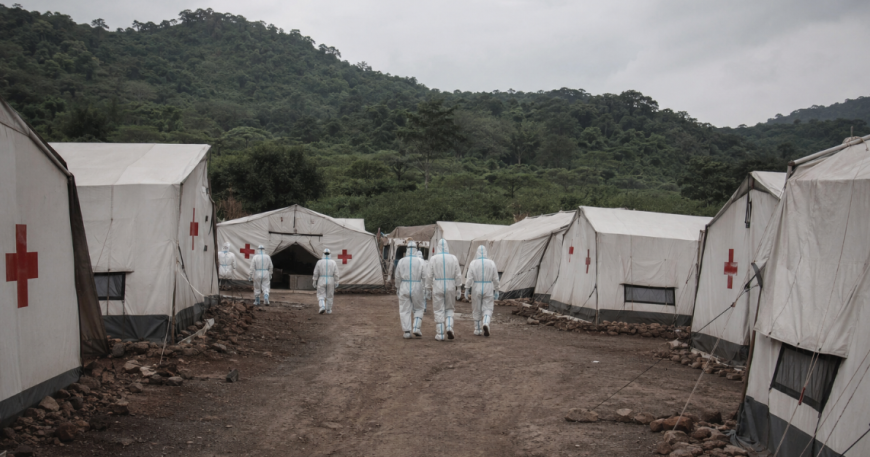
This is not a routine Ebola event. The World Health Organization has declared a public health emergency of international concern over an outbreak of a rarer Ebola species for which no vaccine or specific treatment is approved.
On 5 May 2026, the World Health Organization was alerted to a cluster of unexplained, high-mortality illness in Mongbwalu, a health zone in Ituri Province in the eastern Democratic Republic of the Congo. Laboratory analysis by the National Institute of Biomedical Research confirmed Bundibugyo virus infection in eight of thirteen samples collected from suspected cases. Patients presented with fever, generalised body pain, weakness, vomiting and, in some cases, bleeding, with several deteriorating rapidly and dying.
This is the seventeenth recorded Ebola outbreak in the DRC since the virus was first identified in 1976, and the previous outbreak in the country had only ended in December 2025.
It is only the third outbreak on record specifically caused by the Bundibugyo species, following outbreaks in Uganda in 2007 to 2008 and in DRC in 2012.
A Formally Declared Emergency
On 17 May 2026, the WHO Director-General formally determined, after consulting the relevant states, that the outbreak constitutes a public health emergency of international concern under the International Health Regulations, whilst assessing that it did not meet the separate threshold of a pandemic emergency.
The Current Picture
According to the European Centre for Disease Prevention and Control’s update of 26 June, the DRC Ministry of Health has reported a total of 1,155 confirmed cases and 304 confirmed related deaths, with 385 individuals hospitalised in isolation as of 24 June. Ituri remains the most affected province, with 1,054 confirmed cases reported across 22 health zones, North Kivu has recorded 98 confirmed cases across 11 health zones, and South Kivu three cases in one health zone.
The outbreak has also produced a small number of cases outside Africa. One confirmed case was reported in France on 24 June, in addition to an earlier case in a US citizen who was medically evacuated to Germany for treatment on 19 May, both linked to travel from the affected areas of the DRC. The ECDC has assessed the likelihood of onward infection within the EU and EEA as very low.
Why Bundibugyo Is Clinically Different
The Bundibugyo species was first identified in Uganda in 2007 and has historically been associated with somewhat lower case fatality rates than other Ebola species, though previous outbreaks have still recorded mortality of approximately 25% to 50%.
The gap in available countermeasures is specific to this species. Vaccines exist for Ebola, but not as approved countermeasures for Bundibugyo virus disease. The Ervebo vaccine is used in a ring vaccination strategy targeting the contacts of confirmed cases, but it was developed and validated against the Zaire species, and is not approved for use against Bundibugyo virus infection. In the absence of an approved treatment, care relies primarily on supportive therapy: managing symptoms such as fever and vomiting and supporting patients through the acute phase of illness. Supportive care of this kind remains genuinely lifesaving, even without a targeted antiviral or species-specific vaccine.
The Compounding Factors on the Ground
The outbreak’s setting has made containment substantially harder than it would be elsewhere. It is occurring in areas affected by insecurity, population displacement, mining-related population movement and frequent cross-border travel, all of which increase the risk of further transmission.
Contact tracing, the central tool for breaking chains of transmission, struggled significantly in the outbreak’s early weeks, when the follow-up rate for listed contacts in Ituri province stood at only 21%, hampered by insecurity and movement restrictions. A month into the response, WHO’s own emergency response lead for Africa, Dr Rose Belizaire, assessed overall progress at roughly three or four out of ten against where the response needs to be, noting that the outbreak was evolving rapidly and that all partners needed to step up their efforts to keep pace.
The response has nonetheless scaled up considerably. By mid-June, some 400 treatment beds were available and four laboratories were operational, with two of them able to process nearly 1,000 samples a day between them. Cross-border cooperation has also strengthened: authorities in the DRC and Uganda agreed to deploy joint response teams along their shared border, strengthen joint laboratory capacity, and establish a treatment centre jointly managed by teams from both countries, reflecting how closely connected the populations living on either side of the border are.
What Comes Next
The outbreak is being fought without a validated species-specific vaccine, relying instead on isolation, contact tracing, safe burial practice and community engagement. WHO has noted that community mistrust remains a significant challenge to the response.
With contact tracing still working to reach adequate coverage and no vaccine validated for this specific species, the scale of international support mobilised in the coming weeks is likely to shape how this outbreak is ultimately remembered.
Sources: World Health Organization, European Centre for Disease Prevention and Control, UN News.