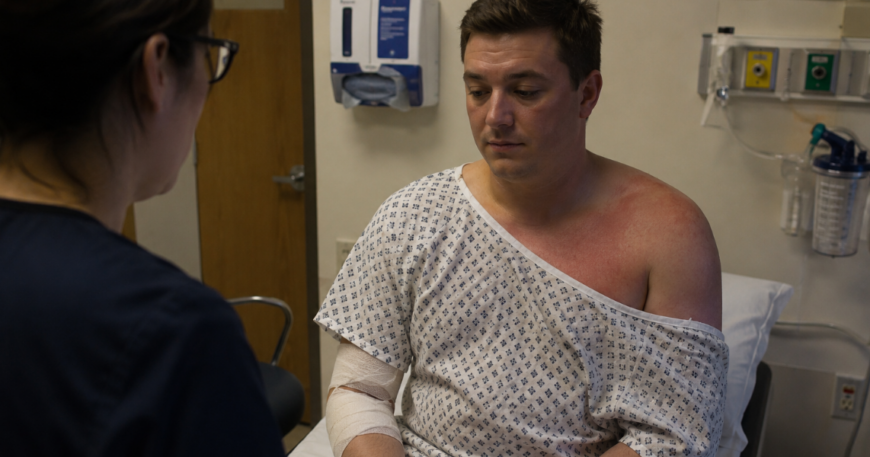
The U.S. Food and Drug Administration (FDA) has granted De Novo clearance to Spectral AI’s DeepView System, marking a significant regulatory milestone for artificial intelligence in emergency and wound care.
The clearance allows the company to begin commercial distribution of the technology in the United States and highlights growing momentum behind AI-enabled diagnostics designed to support faster clinical decision-making.
The DeepView System uses artificial intelligence and imaging technology to assess burn wounds and predict healing potential from the first day of injury. The system is intended for use across burn centres, trauma units and emergency departments, where early assessment can play a critical role in determining treatment pathways.
The decision reflects a wider shift taking place across healthcare and medtech, where regulators are increasingly evaluating AI-driven tools designed to improve diagnostic accuracy, reduce delays and support overstretched clinical teams.
Why burn assessment remains a major clinical challenge
Accurately evaluating burn severity in the early stages of treatment has long been difficult for clinicians.
Current assessment methods often rely heavily on visual inspection and clinical judgement, which can vary between practitioners. Determining whether a burn will heal naturally or require surgical intervention may take several days, delaying treatment decisions and potentially affecting patient outcomes.
According to Spectral AI, the DeepView System combines multispectral imaging with predictive AI algorithms to provide an immediate assessment of tissue healing potential.
The FDA clearance was granted through the agency’s De Novo pathway, which is used for novel medical devices that do not have an existing legally marketed equivalent.
Vincent Capone, Chief Executive Officer of Spectral AI, described the decision as “a defining moment” for the company and said the clearance validates years of development work focused on predictive medical technology.
The approval also underlines how regulators are becoming more comfortable with AI-enabled diagnostic systems in clinical environments, particularly where they can address clear unmet needs.
AI diagnostics continue moving into frontline healthcare
The clearance comes during a period of rapid growth in AI-based healthcare technologies.
Over the past year, regulators in both the United States and Europe have approved an increasing number of AI-enabled devices across radiology, oncology, cardiovascular care and pathology.
Recent FDA clearances have included AI tools for breast cancer risk prediction, sepsis detection and digital pathology analysis.
Healthcare systems are increasingly exploring whether AI technologies can help improve workflow efficiency, support earlier diagnosis and reduce pressure on healthcare professionals.
However, regulatory agencies are also tightening scrutiny around validation, transparency and real-world performance.
The FDA recently updated guidance around AI-enabled in vitro diagnostic systems, including stricter expectations for validation across manufacturing batches and algorithm consistency.
This reflects broader concerns within the industry around reproducibility, bias and long-term monitoring of AI systems deployed in clinical settings.
As a result, medtech companies developing AI-based products are facing increasing pressure to demonstrate both technical performance and clinical utility.
Commercial opportunity grows for AI-driven medtech
The FDA’s decision could strengthen investor and industry confidence in AI-powered diagnostic platforms.
AI remains one of the fastest-growing areas within medtech investment, particularly in imaging, diagnostics and workflow automation.
Several healthcare technology companies are now pursuing regulatory clearances for tools that combine imaging hardware, predictive algorithms and real-time clinical analytics.
Industry analysts believe emergency medicine and acute care settings could become important growth areas for AI deployment because clinicians often need to make rapid decisions using incomplete information.
Burn care represents a particularly strong use case due to the importance of early intervention and the operational pressures associated with specialist treatment centres.
The commercial success of technologies such as DeepView may depend not only on regulatory approval, but also on integration with hospital systems, reimbursement pathways and clinician adoption.
Healthcare providers continue to evaluate how AI tools fit into existing workflows without increasing administrative burden or introducing new operational risks.
Regulators face balancing act over AI adoption
The rapid pace of AI development in healthcare is creating new challenges for regulators.
Authorities must balance the potential benefits of faster diagnosis and improved efficiency against concerns around patient safety, algorithm reliability and oversight.
The FDA has expanded its own internal AI capabilities in recent months and has also launched initiatives designed to modernise clinical trial infrastructure and digital data systems.
At the same time, policymakers and healthcare organisations are debating how AI-generated clinical recommendations should be monitored and audited once technologies are deployed at scale.
For developers, this means regulatory approval is increasingly becoming only the first stage in a longer process involving post-market surveillance, data governance and real-world evidence collection.
The De Novo clearance for DeepView therefore represents more than a single medtech approval. It signals how AI-based diagnostics are gradually moving from experimental technologies into routine clinical practice.
What happens next
With FDA clearance secured, Spectral AI is expected to begin commercial rollout activities in the United States.
The company said the system is intended for use across multiple clinical settings, including emergency departments and trauma centres.
As hospitals continue investing in digital healthcare infrastructure, AI-powered assessment tools could become increasingly common in frontline medicine.
The wider question for the industry is no longer whether artificial intelligence will play a role in healthcare diagnostics, but how quickly healthcare systems can integrate these technologies safely, effectively and at scale.
For medtech companies, regulators and clinicians alike, the next phase of AI adoption will depend on proving that these tools deliver measurable improvements in patient care rather than simply adding technological complexity.
Sources: FDA, Spectral AI, Reuters, MedTech Dive.