Whether farming method changes how much antimicrobial resistance ends up in the food chain is one of those questions that sounds like it should have a simple answer, organic and free range surely carry less risk than intensive systems built around routine antibiotic use. Two studies published in 2026 complicate that assumption in different ways. One looked at what is actually sitting on food by the time it reaches a shop shelf. The other spent a decade inside a single working dairy farm to see what really drives resistance once you look past the farming label altogether.
At the Shop, Production Method Barely Registers
Researchers at the Quadram Institute, led by Sam Mellor alongside Samuel Bloomfield, Alison Mather and colleagues, examined 223 retail food samples collected in Norfolk between 2018 and 2024, covering pork, beef, lamb, chicken, salmon and leafy greens across three production categories, extensive, wild caught and intensive. Using shotgun metagenomics, a technique that sequences all the microbial DNA present in a sample rather than testing for specific bacteria, the team mapped both the microorganisms and the antimicrobial resistance genes found on each product, work published in Microbial Genomics in April 2026.
The dominant organisms found were spoilage bacteria, Pseudomonas, Lactococcus and Psychrobacter among them, of the kind acquired during processing and storage rather than on the farm itself, and tetracycline and beta lactam resistance genes made up the bulk of the resistance profiles across every food type tested, regardless of how it had been produced. On most measures, production method made no statistically significant difference to antimicrobial resistance gene burden. Chicken and salmon showed some difference in microbial diversity between intensive and extensive or wild caught systems, but the effect size was small. As Mellor put it, “food processing, post farm production, shapes the composition of microbiome on retail food, while the influence of on-farm practices is limited.” The paper’s own conclusion was blunter still, differently produced foods may not present an increased risk of antimicrobial resistance across the commodities the study covered.
Inside One Farm, the Real Drivers Come Into Focus
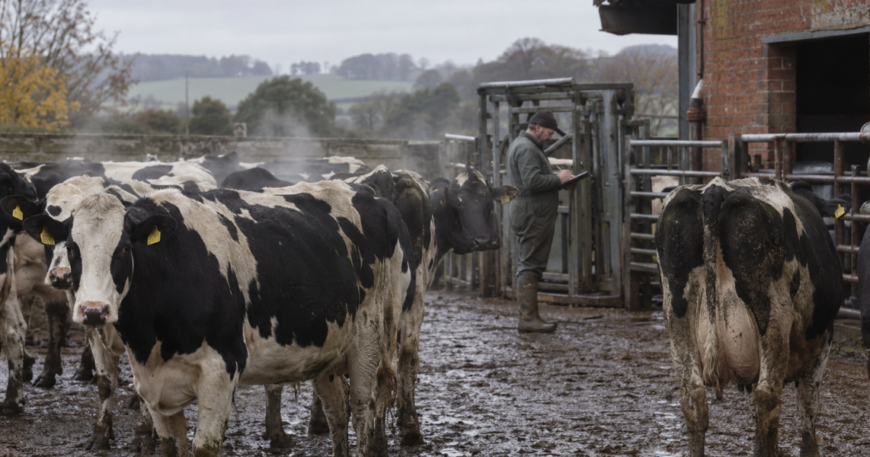
The second study took the opposite approach, going deep rather than wide. A team led by researchers at the University of Nottingham, including Jon Hobman and Dov Stekel, spent ten years studying antimicrobial resistance in waste from a single intensive dairy farm, a 220 cow Holstein Friesian herd in the East Midlands, sampling in two main windows, late 2012 to early 2014 and 2017 to early 2018. The work, published in Frontiers in Veterinary Science in August 2026, combined whole genome sequencing, genetic fingerprinting of E. coli isolates and mathematical modelling to track how resistance actually changed over time.
Resistance levels were stable over short periods but shifted over the long term in step with real changes in antibiotic use on the farm, most clearly when the farm stopped using cephalosporin antibiotics in 2015 and 2016, after which resistance to that drug class fell. The researchers found that resistant strains were spreading mainly through clonal expansion, existing resistant bacteria multiplying and persisting, rather than through resistance genes jumping between different bacteria. A significant driver alongside antibiotics themselves was co-selection by copper, zinc and tetracycline, substances that persist in the farm environment and keep already resistant bacteria at an advantage even when no antibiotic is directly involved. The team also compared resistance patterns in their farm’s E. coli against clinical E. coli from a nearby hospital, and concluded the differences looked more like each sector’s own antibiotic use shaping its own resistance patterns separately, rather than resistant bacteria passing directly between livestock and people. From the decade of data the researchers set out practical priorities for reducing resistance on farms, among them cutting antibiotic use through better infection control, avoiding antibiotics that are also critical in human medicine, managing copper and zinc contaminated waste and storing slurry separately before it goes on fields.
Two Different Answers to a Similar Question
Put side by side, the two studies are not contradicting each other so much as answering different parts of the same question. Whether a product on a supermarket shelf was raised intensively or extensively does not, on this evidence, meaningfully change the antimicrobial resistance risk it carries by the time it reaches a shopper, because what happens during processing after the animal leaves the farm matters more than how it was raised. But inside a working farm itself, resistance is shaped by specific, changeable practices, which antibiotics are used and for how long, and what else, like copper and zinc, is being used alongside them, rather than by whether the farm counts as intensive in the first place. Neither finding supports the simplest version of the usual argument, that buying organic protects a shopper from resistant bacteria, or that intensive farming is straightforwardly the source of the problem. What both studies point to instead is that the details of practice, not the label on the system, are where the actual risk sits.
Sources: Microbial Genomics (Mellor et al, 2026); Quadram Institute; Frontiers in Veterinary Science (Stekel, Hobman et al, 2026).